By: Ong Meng Lap
Introduction to Hooke's Law
Hooke's Law - Hooke's law is a principle of physics that states that the force F needed to extend or compress a spring by some distance X is proportional to that distance (Wikipedia).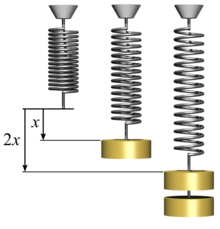 |
| Extension of Spring when applied with different forces. |
- F is the force
- k is the 'spring constant'
- e is the extension
Method
 |
| Table 1. |
- Set up the apparatus similar to Table 1.
- Hang the spring on a support and place a measuring equipment (e.g. ruler) parallel and near to the spring.
- Add an object with known force and observe the scale pointed by the pointer, record the result.
- Repeat method 3 for 8~ 15 times with different weight.
Behaviour of Material y1 and y2

Based on the result obtained, both of these materials can be observed to have a constant reaction to the force applied, both of these materials are getting longer, proportional to the force applied with material "y1" extending/deforming lesser than material "y2" when same amount of forces are applied to both of the materials.
When 2.35N of forces are applied to both materials, the deformation shows the same. This result is obtained through simultaneous equation through matrix using excel.

In point...
- "y2" deforms faster than "y1".
- Both "y1" and "y2" are deforming proportional to the force given.
- Both materials deform at the same amount when applied with 2.35N of force.
One of the possible reason might be due to parallax error as there are possibilities that human make mistakes during the experiment. Another possible might be that the weight added for every measurement might be different thus leading to a different results. There might also be a chance that the equipment used for measurement might have wrong reading or are not properly made by the manufacturer.
In point...
- Might be due to parallax error
- The masses used during the experiment might have different weight
- Equipment used for measurement might have error itself.

Unlike "y1" and "y2", material "z" is observed to be deforming at an increasing rate as more forces are applied to it, it seems that the material is in "plastic region" where force is no longer proportional to the deformation rate which means Hooke's Law is not obeyed in this situation.
In point...
- Unlike "y1" and "y2", material "z" is in "plastic region".
- Material "z" in this situation, does not obey Hooke's Law.
- The graph plotted for material "z" is not linear, force is no more proportional to deformation rate in this case.
Reference
Hooke's Law, Retrieved from https://en.wikipedia.org/wiki/Hooke%27s_law
Hooke's Law, Retrieved from http://www.bbc.co.uk/schools/gcsebitesize/science/add_aqa/forces/forceselasticityrev2.shtml
Determine Spring Constant [Online image]. Retrieved November 16, 2016 from http://libguides.gwumc.edu/c.php?g=27779&p=170351

No comments:
Post a Comment